
A Dome Above Vracar
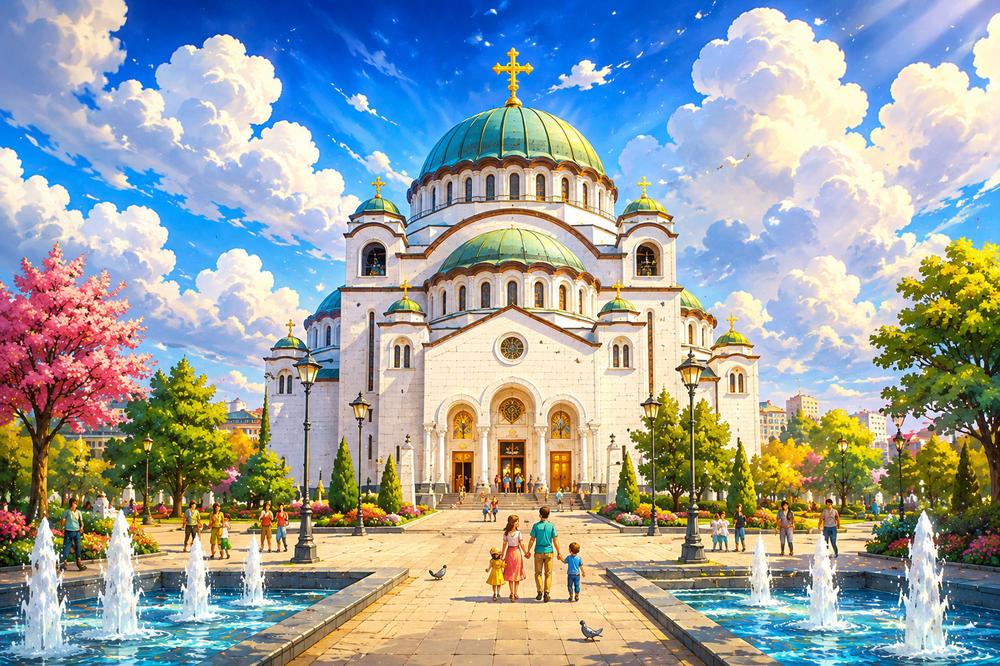
There are buildings that belong to a street, and there are buildings that seem to belong to the entire city. Saint Sava Temple is one of the latter. Its dome appears unexpectedly between apartment blocks, above tree-lined avenues and beyond the roofs of Vracar, always seeming closer than it really is. From a distance it gives Belgrade a ceremonial skyline. Up close, its scale changes the pace of the visitor. The broad plateau opens around it, the facade rises almost vertically from the square, and the city noise begins to feel strangely far away.
The temple is one of the largest Orthodox churches in the world and the largest in Serbia. Yet size alone does not explain its importance. The building was conceived as a national memorial dedicated to Saint Sava, the first archbishop of the autocephalous Serbian Orthodox Church, a medieval prince who became a monk, diplomat, writer, educator and one of the central figures of Serbian spiritual and cultural history.
The Man Behind the Monument
Saint Sava was born Rastko Nemanjic, a son of Grand Prince Stefan Nemanja. Instead of following the expected path of a medieval ruler, he entered monastic life and became one of the architects of Serbian religious and cultural independence. In 1219 he became the first archbishop of the autocephalous Serbian Orthodox Church. His legacy reached far beyond ecclesiastical life: he shaped education, law, literature, diplomacy and the idea of a Serbian cultural community.
Centuries after his death, his relics were taken from the Milesheva Monastery and burned by the Ottoman authorities in Belgrade in the late sixteenth century. Tradition associates that act with the Vracar area. The memory of the burning transformed the plateau into a place of symbolic importance, and the idea of raising a great church there gradually became inseparable from the public memory of Saint Sava himself.
A Century of Interrupted Construction
The story of the temple is almost as dramatic as the history it commemorates. A society dedicated to building a memorial church was founded in Belgrade in 1895. Architectural competitions followed, along with years of debate about style, location and scale. The final design developed from the work of architects Bogdan Nestorovic and Aleksandar Deroko, who turned toward the Serbian-Byzantine tradition and the great domed churches of the medieval Orthodox world.
Construction began in 1935. For several years the walls rose steadily, but the Second World War stopped the work in 1941. The unfinished structure then stood for decades as a massive shell on Vracar. It was not simply an incomplete building. It became a visible reminder of interrupted history, changing governments and the uncertain relationship between religion and public life in socialist Yugoslavia.
Permission to resume construction finally came in the 1980s. Work restarted in 1985 under architect Branko Pesic, who respected the earlier architectural concept while adapting the project to modern structural methods. One of the most extraordinary engineering moments came in 1989, when the enormous central dome, assembled at ground level, was lifted into position. The exterior was substantially completed in the early twenty-first century, while interior decoration continued on a scale worthy of the building itself.
Architecture That Looks Back and Forward
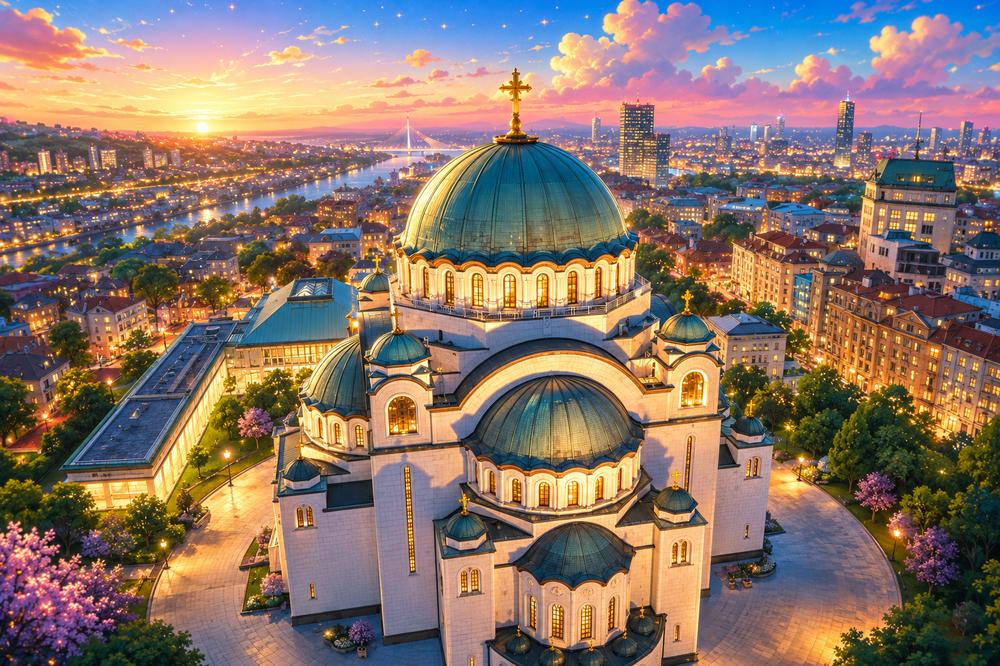
Saint Sava Temple is often described as Serbian-Byzantine in style. The phrase is useful, but the building is not a simple reproduction of a medieval church. Its proportions, construction methods and urban role belong to the modern era. What it borrows from Byzantine architecture is the language of the great central dome, the hierarchy of surrounding spaces, the rhythm of arches and semi-domes, and the sense that the interior should rise toward a single luminous center.
The influence of Hagia Sophia in Istanbul is frequently noted, especially in the idea of an immense domed sacred space. Yet Saint Sava has its own unmistakable identity. Pale stone, green copper roofs and gilded crosses give the exterior a restrained dignity. The building is monumental without depending on excessive ornament. From the plateau, the composition feels balanced and calm, even though the structure itself is enormous.
The central dome has an internal diameter of about 30.5 metres. Seen from below, however, measurements become almost irrelevant. The eye follows the curve upward until architecture begins to dissolve into image, gold and light.
Inside the Golden World
The interior is the moment when many first-time visitors stop speaking. The scale outside prepares you for grandeur, but not for the sudden intensity of the mosaics. Gold dominates the upper surfaces, catching both daylight and artificial illumination. Figures appear at a scale suited to the architecture, not to ordinary human rooms. The effect is deliberately otherworldly.
The mosaic program covers many thousands of square metres and follows the visual language of Byzantine sacred art while using modern materials and contemporary production methods. The dome is crowned by a monumental representation of the Ascension of Christ. Beneath it, the entire interior becomes a carefully organized theological landscape, with saints, angels, biblical scenes and ornamental fields arranged according to the logic of Orthodox church space.
The National Tourism Organisation of Serbia describes the mosaic decoration as one of the most impressive achievements of contemporary church art. That judgment makes sense when viewed from the floor. The mosaics are not merely decoration applied to architecture. They are part of the architecture's purpose. Gold changes the perceived depth of the surfaces, figures give scale to the dome, and the building becomes visually complete only when stone, volume and image are experienced together.
The Crypt Below
Beneath the main church lies another world. The crypt is lower, more intimate and visually denser, with polished stone, gilded detail and richly colored sacred imagery. If the main temple creates awe through height and openness, the crypt works through closeness. The ceiling comes down toward the visitor, decorative surfaces become easier to examine, and the atmosphere feels more contemplative.
It is worth visiting both spaces because they reveal two different emotional registers of the same complex. Above, the temple speaks in monumental scale. Below, the crypt speaks in detail, enclosure and stillness.
The Temple and the City Around It
Saint Sava Temple does not stand in isolation. The Vracar plateau is part of the experience. Wide approaches give the church the distance it needs to be seen properly, while the surrounding district returns the visitor almost immediately to everyday Belgrade - cafes, bakeries, schools, apartment buildings and busy streets.
Nearby are the National Library of Serbia, Karadjordje Park and the smaller Church of Saint Sava. The broader Vracar neighborhood is one of the most pleasant areas of central Belgrade to explore on foot. It is residential and urban at the same time, with a rhythm very different from the historic center around Knez Mihailova and Kalemegdan.
This contrast is part of the temple's appeal. A place charged with national memory and sacred symbolism is woven directly into the life of a modern neighborhood. People cross the plateau on their way home, children play nearby, worshippers arrive for services, tourists photograph the dome, and the building remains both extraordinary and completely present in everyday city life.
How to Visit
Saint Sava Temple is in Vracar at Krusedolska 2a. The official temple website currently lists daily opening hours for the main temple from 08:00 to 20:00, while the smaller church operates on a slightly different schedule. Service times and special events can change, so it is sensible to check the official schedule on the day of your visit.
Allow at least an hour for a first visit if you want to experience the main interior, walk around the building and see the crypt without rushing. Stay longer if you enjoy architecture, sacred art or photography. Morning visits can be quieter, while late afternoon often gives the exterior softer light and a warmer tone.
- Dress respectfully: this is an active place of worship, not simply a monument.
- Keep your voice low: especially during services and in the crypt.
- Do not rush the interior: the mosaics make more sense when viewed first as a whole and only then in detail.
- Walk around the plateau: the best understanding of the architecture comes from seeing the temple from several distances and angles.
- Continue through Vracar: combine the visit with a walk toward Slavija, Karadjordje Park or the neighborhood's cafes and side streets.
Why Saint Sava Stays With You
Many famous buildings impress because they are old. Saint Sava Temple is different. Its power comes partly from the fact that its history is so recent and so visibly unfinished in the historical sense. The idea was born in the nineteenth century, construction began in the 1930s, war stopped it, politics delayed it, engineering revived it, and artists of the twenty-first century gave the interior its golden visual language.
That long chronology can be felt inside the building. Saint Sava Temple is not a preserved fragment of one period. It is a structure made by several generations who inherited the same unfinished task. This gives it a rare emotional quality: it is both memorial and continuation.
For visitors to Belgrade, the temple is worth seeing not only because it is large or beautiful, but because it explains something essential about Serbia. History here is rarely contained neatly in the past. It remains active in public space, architecture, faith, language and memory. On Vracar, all of those layers rise together beneath one dome.
← Back to Home Page